Video review — tap to play
The Courage to Be Disliked: The Japanese Phenomenon That Shows You How to Change Your Life and Achieve Real Happiness
Counseling & Psychology, Health, Fitness & Dieting, Mental Health, Mood Disorders
Written as a dialogue between a skeptical young man and a philosopher, this Japanese bestseller introduces the ideas of psychologist Alfred Adler. Across five nights of conversation, it argues that people are not determined by past trauma, that all problems are interpersonal, and that freedom requires accepting that some people will dislike you.
- Release Date
- 2013
- Publisher
- Diamond, Inc.
We may earn a commission if you buy through these links, at no extra cost to you.
Our Review
About the book
Written as a dialogue between a skeptical young man and a philosopher, this Japanese bestseller introduces the ideas of psychologist Alfred Adler. Across five nights of conversation, it argues that people are not determined by past trauma, that all problems are interpersonal, and that freedom requires accepting that some people will dislike you.
Our review
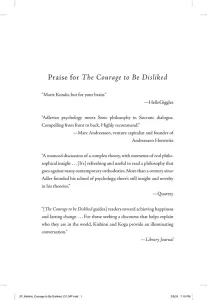
A Socratic sparring match that makes Adlerian psychology feel urgent, provocative and oddly liberating.
Kishimi and Koga’s choice of form is the book’s masterstroke. Instead of lecturing, they stage a debate: an angry, wounded young man challenges a calm philosopher on every claim, which lets readers voice their own objections along the way. The ideas are bracing, among them the rejection of trauma as destiny, the separation of tasks between yourself and others, and the claim that the desire for recognition traps us. Even where you disagree, you are forced to think.
The dialogue format does have costs. The youth’s outbursts can feel theatrical, the philosopher sometimes wins arguments by assertion, and the dismissal of trauma is likely to strike many readers, particularly those with clinical experience, as too sweeping. It is a philosophy of life rather than a clinical guide. Approached that way, it is one of the most stimulating and genuinely different self-help books of the past decade.
What we loved
- The engaging dialogue format that anticipates objections
- Clear introduction to Adler’s rarely popularized ideas
- Practical concept of separating your tasks from others’
Keep in mind
- Its stance on trauma can feel dismissive and oversimplified
- The young man’s theatrics and repetition can grate
Read it if you like
readers of Man’s Search for Meaning, fans of Sophie’s World, anyone stuck seeking others’ approval
The verdict
Provocative and freeing; a self-help book that argues with you, and is better for it.