A Brief History of Intelligence
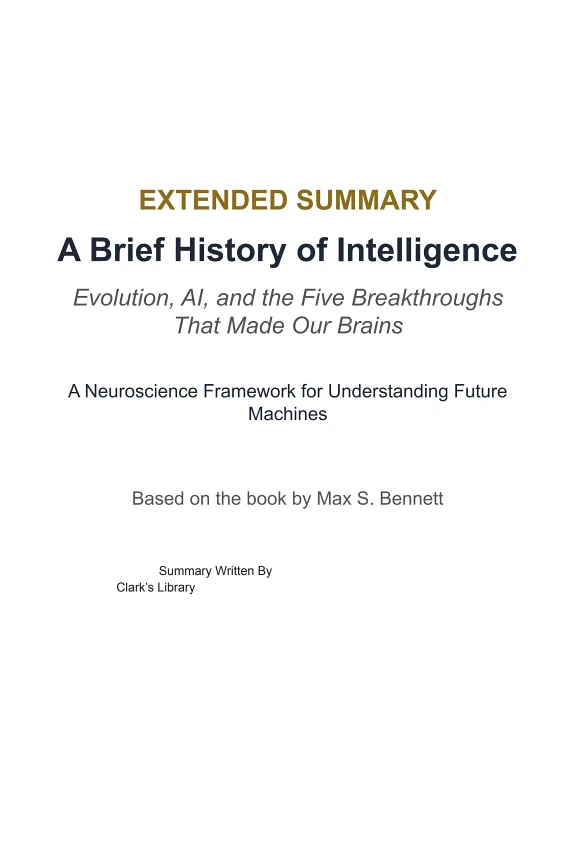
What if the difference between your brain and a chatbot came down to five missing ingredients? For decades, scientists chased a single explanation for intelligence — one neuron, one circuit, one algorithm that would unlock it all. They never found it, because it never existed. Intelligence wasn't built in one leap. It was assembled over 600 million years, in five separate evolutionary breakthroughs, each solving a problem the last one couldn't touch. Miss even one of those layers, and you can build something that talks like a genius and still can't tell you why a joke is funny. That's the trap most readers — and most AI builders — fall into. They read the headlines about artificial intelligence, they marvel at what machines can now do, and they still can't explain why the same systems fail at things a toddler does without trying. This extended summary and study guide exists to close that gap. Built from the framework of Max S. Bennett's acclaimed book on brain evolution and artificial intelligence, it distills the five breakthroughs — Steering, Reinforcing, Simulating, Mentalizing, and Speaking — into a clear, chapter-by-chapter companion designed for readers who want the ideas to actually stick, not just wash over them. Inside, you'll find a complete evolutionary roadmap of the mind: how the first nervous systems learned to choose a direction, how dopamine turned trial and error into real learning, how the mammalian brain learned to imagine a future before living it, how primates learned to read each other's intentions, and how language turned individual thought into shared, compounding knowledge. Each chapter opens with a story, a fact, or a question worth sitting with, then breaks the science down into plain language, closing with key takeaways built for fast review. A dedicated frameworks chapter and a full reading-group discussion guide make this an ideal pick for book clubs, students of neuroscience and cognitive psychology, and anyone trying to think clearly about where artificial intelligence is actually headed. If you've ever wondered why your favorite AI tool can write a poem but can't tell when it's about to hurt your feelings, this is the book that explains it — and shows you exactly what's still missing. This is an independently produced summary and study companion, not affiliated with, authorized, or endorsed by the original author or publisher. It is intended purely as an educational aid to accompany the original work. Read it before your next book club meeting. Read it before you make your next assumption about what AI can really do.
- Length
- 54 pages
- Publisher
- C Club