Video review — tap to play
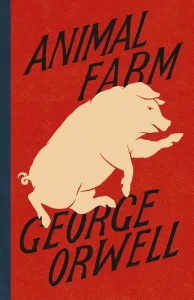
Animal Farm: (Authorized Orwell Edition)—A Mariner Books Classic (An Hbj Modern Classic)
Dystopian, Science Fiction, Science Fiction & Fantasy, Teen and Young Adult
The animals of Manor Farm have revolted and taken over. Upon the death of Old Major, pigs Snowball and Napoleon lead a revolt against Mr. Jones, driving him from the farm. The animals embrace the Seven Commandments of Animalism and life carries on, but in this classic dystopian novel, they learn that a farm ruled by animals looks more human than ever.
- Release Date
- 1945
- Publisher
- Secker & Warburg
We may earn a commission if you buy through these links, at no extra cost to you.
Our Review
About the book
George Orwell’s allegorical novella follows the animals of an English farm who overthrow their human farmer in hopes of creating an equal society. Under the leadership of the pigs, the revolution’s ideals gradually erode as power concentrates and history is rewritten, mirroring the course of the Russian Revolution and Stalinism.
Our review
A barnyard fable that reads in an afternoon and stays with you for a lifetime.
Orwell’s genius here is compression. In barely a hundred pages, he tells a story simple enough for a child to follow and pointed enough to dissect a revolution’s betrayal. The animals are drawn with economy, each a recognizable type: the loyal laborer, the opportunist, the propagandist, the bystanders who prefer not to notice. The plain, fairy-tale prose makes each small erosion of principle feel inevitable, which is precisely what makes it chilling.
Readers who know the history of the Soviet Union will spot direct parallels, but the book’s power does not depend on them; it is equally sharp about propaganda, complacency and the way language is bent to excuse power. Its allegory is deliberately schematic, so anyone looking for psychological depth or narrative surprise will find little. That simplicity is a choice rather than a flaw, though it does make the book feel more like a lesson than a novel at times.
What we loved
- Remarkably concise and accessible
- Timeless insight into propaganda and power
- Memorable characters drawn with economy
Keep in mind
- Allegory is schematic, with little character depth
- Its didactic purpose is always visible
Read it if you like
Nineteen Eighty-Four by George Orwell, Lord of the Flies by William Golding, readers interested in political fiction
The verdict
A short, devastating classic that every reader should encounter at least once, and probably revisit.