Video review — tap to play
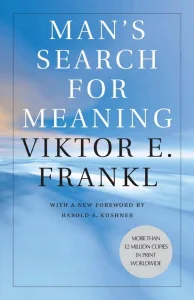
Man’s Search for Meaning
Advice and How-To, General Nonfiction
What remains when almost everything has been taken away? In Man’s Search for Meaning, psychiatrist Viktor Frankl recounts his experiences in Nazi concentration camps and reflects on how people endure suffering, loss, and uncertainty. Drawing from both his own experiences and his later work as a psychiatrist, Frankl introduces logotherapy—the idea that the search for personal meaning can become a central force in life. Rather than promising freedom from suffering, the book explores how finding purpose can shape the way we face hardship and move forward.
- Release Date
- 1946
- Length
- 165 pages
We may earn a commission if you buy through these links, at no extra cost to you.
Our Review
About the book
Psychiatrist Viktor Frankl recounts his experiences as a prisoner in Nazi concentration camps and observes how inmates coped with suffering. He then introduces logotherapy, his therapeutic approach centered on the human drive to find meaning.
Our review
A slim book with enormous gravity: testimony from the camps and a quiet argument for meaning that has outlasted its era.
Frankl writes about Auschwitz and Dachau with startling restraint. He does not dwell on spectacle; he watches people, noting who held on and what seemed to help, and draws from those observations a conviction that we retain a final freedom in how we respond to circumstances. The first half is among the most humane eyewitness accounts of the Holocaust we have read, and its brevity makes each detail hit harder.
The second part, which outlines logotherapy, is drier and more clinical, and some readers will find it a letdown after the memoir. Frankl’s emphasis on choice can also be misread as blaming those who could not endure, a reading he did not intend but does not fully guard against. These are small reservations. Few books earn the word essential, but this one comes close, and it repays rereading at every stage of life.
What we loved
- Restrained, observant testimony from inside the camps
- A powerful, practical philosophy of meaning
- Short enough to read in a sitting and revisit often
Keep in mind
- The logotherapy section is drier than the memoir
- Its focus on choice can be misread as minimizing suffering
Read it if you like
Readers of Primo Levi’s Survival in Auschwitz, Elie Wiesel’s Night, or Marcus Aurelius’s Meditations.
The verdict
Brief, devastating and consoling at once; a book that belongs on nearly every shelf.