Video review — tap to play
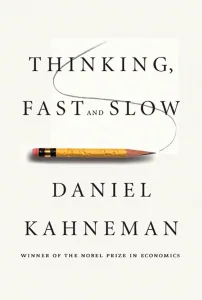
Thinking, Fast and Slow
Nobel laureate Daniel Kahneman lays out decades of research on judgment and decision-making, organized around two modes of thought: a fast, intuitive system and a slow, deliberate one. The book explores biases, heuristics, overconfidence, prospect theory and the gap between the experiencing and remembering self.
- Release Date
- 2011
- Length
- 611 pages
- Publisher
- Penguin UK
We may earn a commission if you buy through these links, at no extra cost to you.
Our Review
About the book
Nobel laureate Daniel Kahneman lays out decades of research on judgment and decision-making, organized around two modes of thought: a fast, intuitive system and a slow, deliberate one. The book explores biases, heuristics, overconfidence, prospect theory and the gap between the experiencing and remembering self.
Our review
The book that taught a generation to distrust its own hunches, written by the researcher who did much of the work.
Few popular science books carry this much authority. Kahneman is not summarizing other people’s findings; he is walking us through experiments he and Amos Tversky designed, and his affection for that partnership gives the book an unexpected warmth. The two-systems framing is a clever teaching device, and the puzzles he sets for the reader are humbling in the best way. We kept catching ourselves making the very errors he had just described.
It is also long and uneven. The middle sections on statistics and regression demand patience, and the later material on well-being feels like a different book stapled on. Some studies cited in the priming chapter have since failed to replicate, a problem Kahneman himself later acknowledged. Read it with that asterisk in mind. Even so, its core lessons about overconfidence, framing and loss aversion have held up remarkably well and will change how you read the news.
What we loved
- Firsthand account of landmark research from its originator
- Interactive puzzles that expose the reader’s own biases
- A generous portrait of the Kahneman-Tversky collaboration
Keep in mind
- Some priming research it relies on has not replicated
- Dense and sprawling; the final section loses focus
Read it if you like
Fans of Predictably Irrational by Dan Ariely, Nudge by Thaler and Sunstein, or The Undoing Project by Michael Lewis.
The verdict
Demanding and occasionally dated, but in our view still the essential book on how human judgment goes wrong.