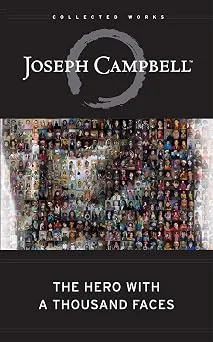
The Hero with a Thousand Faces (The Collected Works of Joseph Campbell)
Folklore & Mythology, Politics & Social Sciences Social Sciences
What if the stories we’ve told for thousands of years are all variations of the same journey? In *The Hero with a Thousand Faces*, Joseph Campbell explores the universal patterns found across the world’s myths, introducing the influential concept of the Hero’s Journey—a cycle of departure, transformation, and return that appears again and again in stories of adventure and discovery. Drawing on comparative mythology and psychology, Campbell also examines the mythic cycle of creation and destruction. Thought-provoking and deeply influential, this classic explores why humans tell stories and what those stories reveal about our shared search for meaning, identity, and transformation.
- Release Date
- 1949
- Length
- 416 pages
- Publisher
- Pantheon Books
We may earn a commission if you buy through these links, at no extra cost to you.
Our Review
About the book
Joseph Campbell’s 1949 study of comparative mythology argues that myths from cultures around the world share a common underlying structure, which he calls the monomyth or hero’s journey. Drawing on folklore, religion and psychoanalysis, he traces the stages of departure, initiation and return.
Our review
The book that taught Hollywood how to tell stories, and still a dazzling tour through the world’s myths.
Few works of scholarship have shaped popular culture so directly. Campbell’s map of the hero’s journey has influenced filmmakers, novelists and screenwriting manuals for decades, and reading the source is a revelation: you start spotting the pattern everywhere. The sheer range is the joy here, as he moves between Greek, Hindu, Buddhist, Native American and medieval tales on a single page, building a case for a shared human imagination.
That ambition is also its weakness. The prose is dense and the Freudian and Jungian framework feels dated, and critics have long argued that Campbell smooths over real differences between cultures to fit his template. It is not a quick read; expect to work for it. We would recommend it to storytellers and myth lovers who want the original rather than the simplified workshop versions, read with a healthy dose of skepticism.
What we loved
- Enormous breadth across world mythologies
- Endlessly useful for writers and storytellers
- Changes how you watch films and read novels
Keep in mind
- Dense, academic prose with a heavy psychoanalytic slant
- Its universal pattern can oversimplify diverse traditions
Read it if you like
writers who liked Christopher Vogler’s The Writer’s Journey, fans of Joseph Campbell’s The Power of Myth, mythology buffs
The verdict
Challenging and sometimes overreaching, but a foundational book for anyone who cares how stories work.