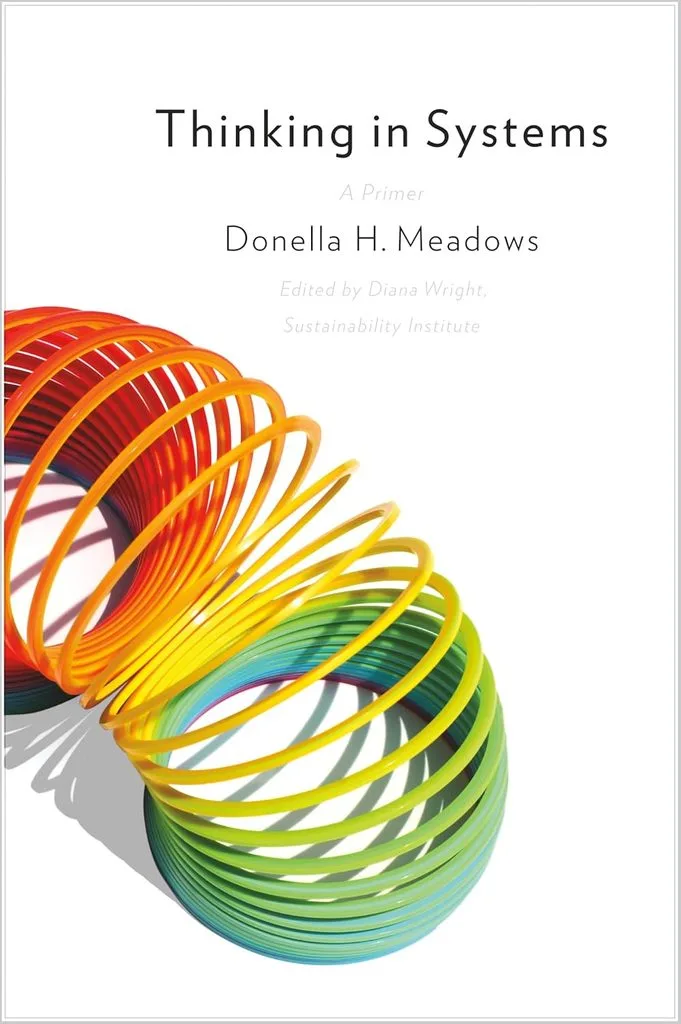
Thinking in Systems: International Bestseller
Management, Management & Leadership Management Skills
What if the problems we struggle to solve are actually problems with the systems around them? In *Thinking in Systems*, Donella Meadows introduces a practical way to understand how complex systems work and why changing one part can produce unexpected effects elsewhere. From personal decisions to global challenges such as poverty, conflict, and environmental degradation, the book shows how relationships, feedback loops, delays, and underlying structures shape outcomes. Clear and thought-provoking, it provides a framework for seeing beyond isolated problems and approaching an increasingly interconnected world with greater awareness and effectiveness.
- Release Date
- 2008
- Length
- 240 pages
- Publisher
- Chelsea Green Publishing
We may earn a commission if you buy through these links, at no extra cost to you.
Our Review
About the book
Environmental scientist Donella H. Meadows offers an accessible introduction to systems thinking, explaining stocks, flows, feedback loops and delays. The book covers why systems behave in surprising ways, common traps, and the leverage points where change is most effective.
Our review
The clearest primer on feedback loops ever written, and a quiet revolution in how you see problems.
Meadows, lead author of The Limits to Growth, wrote this primer before her death in 2001, and it was edited for publication afterward. It teaches a way of seeing: bathtubs filling and draining, thermostats correcting, populations overshooting. Simple diagrams build steadily into explanations of why policies backfire, why markets oscillate and why good intentions get swallowed. The chapter on system traps and the essay on leverage points are among the most influential pieces of thinking in the field.
The book is brief and occasionally abstract, and its early chapters, heavy on stock-and-flow diagrams, can feel like a textbook before the payoff arrives. Its examples sometimes date to earlier debates in economics and environmental policy. Readers wanting rigorous modeling will need further resources. But for managers, policymakers, students and curious readers, it offers a durable mental toolkit that keeps paying off for years.
What we loved
- Exceptionally clear explanations of feedback loops and delays
- The influential discussion of leverage points
- Applicable to business, policy, ecology and daily life
Keep in mind
- Early diagram-heavy chapters can feel dry
- Some examples feel dated
Read it if you like
readers of The Fifth Discipline, fans of Thinking, Fast and Slow, students of policy, ecology or management
The verdict
An essential, endlessly applicable primer that changes how you see the world’s problems.