Video review — tap to play
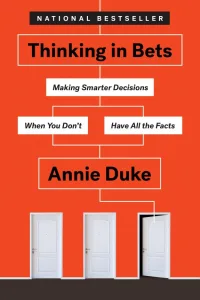
Thinking in Bets: Making Smarter Decisions When You Don’t Have All the Facts
Decision-Making & Problem Solving Management & Leadership
What if a good decision can still lead to a bad outcome? In *Thinking in Bets*, former World Series of Poker champion Annie Duke explores how uncertainty, incomplete information, and luck shape the decisions we make. Using examples from poker, business, sports, and everyday life, she shows why judging a decision solely by its outcome can lead to flawed thinking. Instead, Duke encourages readers to think in probabilities, question their assumptions, and separate luck from decision quality. The result is a practical framework for making smarter, calmer decisions when certainty is impossible.
- Release Date
- 2018
- Length
- 288 pages
- Publisher
- Portfolio
We may earn a commission if you buy through these links, at no extra cost to you.
Our Review
About the book
Former professional poker player Annie Duke explores how to make better decisions when information is incomplete and luck plays a role. She argues that people should judge choices by their process rather than their outcomes, and offers tools for calibrating beliefs and learning from experience.
Our review
A poker champion’s case that a good decision can lose and a bad one can win, and why that matters.
Duke’s central warning is against resulting, judging decisions purely by how they turned out. Drawing on poker, cognitive science and memorable examples, including a famous football play call, she shows how luck and hidden information muddy our learning. Her tools are practical: treat beliefs as bets with probabilities, build truth-seeking groups, and imagine future regret. For anyone who makes calls under uncertainty, the reframe is genuinely clarifying.
The book’s core insight arrives early, and the remaining chapters circle it more than they deepen it. Poker anecdotes are vivid but repetitive, and readers familiar with Kahneman or Tetlock will recognize much of the underlying research. It is a popularization rather than a new theory. Still, Duke writes clearly and with personality, and as an accessible introduction to probabilistic thinking, it is hard to beat.
What we loved
- The powerful concept of resulting
- Practical habits for thinking probabilistically
- Vivid examples drawn from poker
Keep in mind
- The main idea is stated early and then repeated
- Much of the research will be familiar to behavioral economics readers
Read it if you like
readers of Thinking, Fast and Slow, fans of Superforecasting, managers and investors
The verdict
A clear, persuasive primer on deciding under uncertainty, even if it makes its point a little too many times.